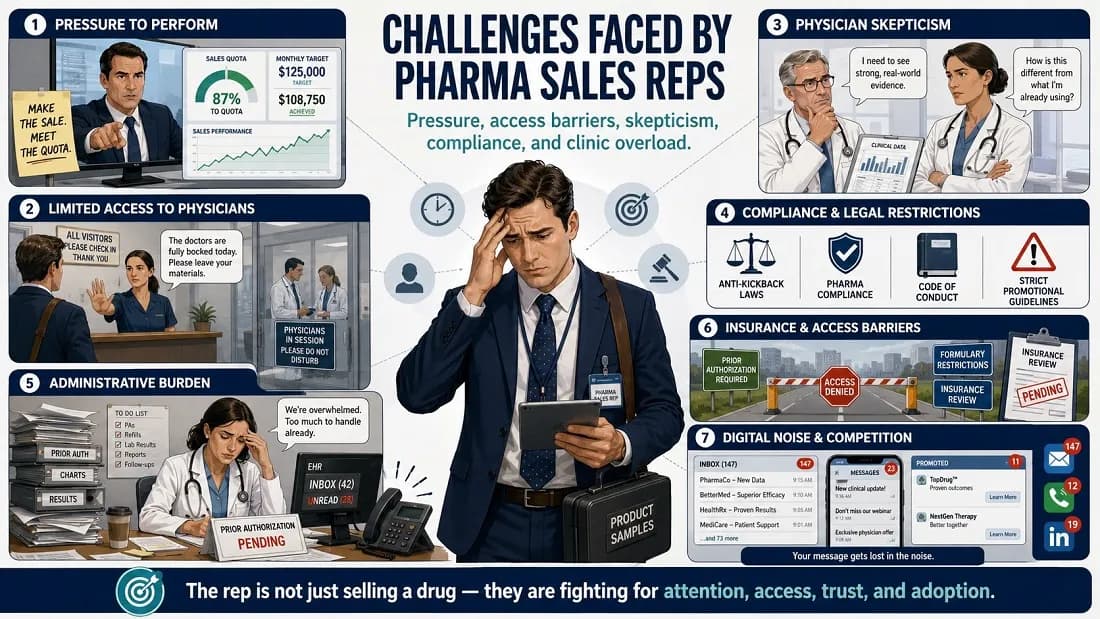
Pharma sales reps struggle because the clinic environment is busy, regulated, skeptical, and operationally overloaded. The rep may have a useful product message, but the physician and clinic often see the interaction as one more interruption in an already crowded day.
1. Limited access to physicians
The biggest challenge is simply getting face time.
Many clinics restrict rep visits because physicians are busy with patient care, charting, messages, labs, refills, prior authorizations, and staff questions. Even when reps are allowed in, they may only get a few minutes between patients.
Common barriers include:
- Front desk blocks access
- Office manager controls rep scheduling
- Physicians refuse walk-ins
- Clinic policy limits vendor visits
- Health systems ban or restrict reps
- Doctors only allow certain reps they already trust
- No lunch, no samples, or no drop-ins allowed
- Reps get routed to staff instead of the physician
The result: the rep's main obstacle is not persuasion, it is access.
2. Physicians are skeptical of sales messaging
Doctors know the rep's goal is to increase prescriptions. Even if the drug is clinically useful, physicians often question whether the message is balanced.
Physicians may think:
- Is this really better than what I already use?
- Is the data strong enough?
- Are they downplaying side effects?
- Will this be covered?
- Will prescribing this create more work for my staff?
- Is this just another expensive branded drug?
This skepticism is normal. Physicians are trained to be evidence-driven, not marketing-driven.
3. Compliance restrictions limit what reps can say or do
Pharma reps operate under strict rules. They must stay within approved product labeling and cannot casually discuss off-label use, make unsupported claims, or offer anything that could appear to improperly influence prescribing.
This creates tension. Physicians may ask practical questions that the rep cannot fully answer, especially if the question touches on off-label use, comparative claims, unpublished data, or payer-specific issues.
Reps also have to be careful with:
- Meals
- Samples
- Speaker programs
- Patient materials
- Copay cards
- Fair balance
- Adverse event reporting
- Sunshine Act reporting
- Anti-Kickback concerns
- Inappropriate inducement concerns
The rep may want to be helpful, but legal and compliance rules narrow the interaction.
4. Clinic staff may see reps as disruptive
Physicians are not the only gatekeepers. Medical assistants, nurses, office managers, front desk staff, billing staff, and prior authorization staff can all shape whether the rep is welcomed or blocked.
If the clinic is running behind, a rep visit can feel like a distraction. Staff may worry the rep will slow down rooming, interrupt doctors, take up lunch time, or add new tasks.
Common staff reactions:
- The doctor is too busy.
- Leave the material at the front.
- We are not seeing reps today.
- You need an appointment.
- Email it.
- We do not handle samples.
- Prior auth is already too much.
A rep may have to win the staff before ever reaching the doctor.
5. The doctor may like the drug but avoid it because of prior authorization
This is one of the most important real-world problems.
A physician may agree the drug is clinically appropriate, but still hesitate because prescribing it may trigger prior authorization, step therapy, formulary rejection, specialty pharmacy delays, chart documentation requirements, repeated payer calls, appeals, and patient complaints about cost.
From the physician's perspective, a new drug can mean more administrative burden. Even if the rep succeeds clinically, the clinic may think: good drug, but too hard to get approved. That kills adoption.
6. Reps often cannot solve the access problem
Reps can explain the drug, provide materials, and sometimes offer patient support resources. But they usually cannot directly control payer coverage, prior authorization approval, patient deductible, specialty pharmacy delays, office workflow, referral completion, patient adherence, or staff capacity.
This weakens their value to the clinic. The clinic may need operational support more than another product explanation.
7. Physicians are overloaded with competing priorities
A physician's attention is fragmented. On any given day, they may deal with patient visits, documentation, lab results, refill requests, portal messages, phone calls, staff questions, payer denials, quality metrics, administrative meetings, legal and compliance issues, and emergency add-ons.
A rep's product message competes against all of that. Even a strong product can be forgotten if the doctor hears about it for three minutes during a chaotic clinic day.
8. Digital communication is crowded
When reps cannot access physicians in person, they often rely on emails, webinars, virtual details, online portals, texts, or digital ads. The problem: physicians are flooded.
Digital barriers include:
- Low email open rates
- Spam filters
- Generic messaging
- Physician fatigue from webinars
- Lack of personal relationship
- Poor timing
- Limited ability to ask real questions
- Too many competing pharma messages
Digital marketing is scalable, but often less memorable and less trusted.
9. Samples are helpful but operationally complicated
Samples can create goodwill and help patients start therapy, but they also create clinic workload.
Some clinics no longer want samples because they create administrative burden or compliance concerns around storage, expiration, logs, inventory, training, and patient instructions.
10. Product messaging may not match clinic reality
A rep may focus on clinical trial data, mechanism of action, efficacy, and safety. But the clinic may care more about coverage, copay, qualifying diagnosis codes, payer documentation, prior authorization timelines, specialty pharmacy routing, denial workflow, and patient explanation.
If the rep cannot address these practical issues, the message may feel incomplete.
11. Reps must compete against established habits
Doctors often keep using what they already know unless there is a strong reason to change. Familiar drugs, generics, payer-preferred options, clinic protocols, EHR favorites, standing order sets, and prior patient experience all compound into inertia.
A new drug has to overcome that inertia. Better is not enough. It must be meaningfully better, easier, or worth the extra work.
12. New drugs often face payer resistance
Payers may delay adoption of new therapies because they are expensive or lack long-term real-world data. This creates non-formulary status, step therapy, high tier placement, prior authorization, quantity limits, required failed therapies, specialty pharmacy routing, and high patient cost-sharing.
Physicians learn quickly. If the first few prescriptions are denied, they may stop trying.
13. Reps may not have enough local payer knowledge
Physicians often want highly specific payer answers about BCBS, Medicare Advantage, Medicaid, step therapy plans, specialty pharmacy partners, diagnosis codes, and denial workflows.
If the rep only has broad national access information, the clinic may not find it useful. Local payer knowledge is often what changes prescribing behavior.
14. Office staff may not be trained on the product workflow
Even if the physician agrees to prescribe, the staff must execute the process. They need to know how to enroll the patient, where to send the prescription, how to submit prior authorization, what records to include, how to use copay assistance, how to track status, how to handle denial, and how to educate the patient.
If staff are confused, the prescription stalls.
15. Referral patterns may not support the drug
For specialty drugs, the target patient may not already be in the specialist's office. Patients may be stuck in primary care, urgent care, ER, or hospital settings.
This creates a separate challenge: the rep may educate the specialist, but the specialist does not have enough eligible patients coming in. The drug then fails because of referral leakage, not because of poor clinical value.
16. Physicians may worry about patient affordability
A doctor may avoid prescribing a drug if they expect the patient cannot afford it. High deductibles, high copays, coverage uncertainty, abandonment at pharmacy, specialty pharmacy delays, and staff time on cost issues all push physicians toward easier alternatives.
17. Reps have limited time to communicate complex information
Some new drugs are simple to explain. Others require detailed education about mechanism of action, patient selection, contraindications, monitoring, administration, adverse effects, lab requirements, payer requirements, support programs, and comparison to existing therapy. Trying to fit that into a short hallway conversation is difficult.
18. Clinic leadership may care about different things than physicians
The physician may care about clinical benefit. The administrator may care about workflow, compliance, revenue, space, staff workload, and patient satisfaction. A rep may need to satisfy clinical evidence, workflow concerns, logistics, payer access, operational risk, and patient affordability all in one pitch.
If the rep only sells to the doctor, the implementation may still fail.
19. Bad experiences damage future adoption
One failed experience can hurt a drug's reputation inside a clinic. A patient waiting weeks for approval, repeated denials, high copays, missing specialty pharmacy contact, or hours of staff time can all lead the doctor to say: I am not prescribing that again.
20. Reps must create value beyond promotion
The modern clinic does not need more brochures. It needs help reducing friction. A pharma rep is more valuable when they can help the clinic identify eligible patients, gather documentation, avoid denials, source patient education, fit treatment into workflow, surface payer support, route prescriptions correctly, and escalate when access fails.
The strongest reps are not just product promoters. They become practical access-and-education partners while staying compliant. Most reps are also under real performance pressure, but the sale is indirect: the rep is trying to influence the doctor's future prescribing behavior, not close a transaction in the clinic.
That pressure includes call activity, prescription volume, access to restricted clinics, launch adoption, competitive defense, and quota or incentive targets.
Bottom line
Pharma reps struggle because they are trying to introduce new therapies into a system that is already overloaded. The core barriers are limited physician access, physician skepticism, compliance restrictions, staff resistance, prior authorization burden, payer barriers, patient affordability, workflow disruption, and weak referral pathways.
The winning strategy is not just to get in front of the doctor. It is to make the drug easier for the clinic to understand, prescribe, approve, explain, and deliver to the right patient.
Related insights.





Book a call

© Copyright 2025 - 2026 · MedBridge Health · All Rights Reserved · For Physicians · Terms of Use · Privacy Policy