
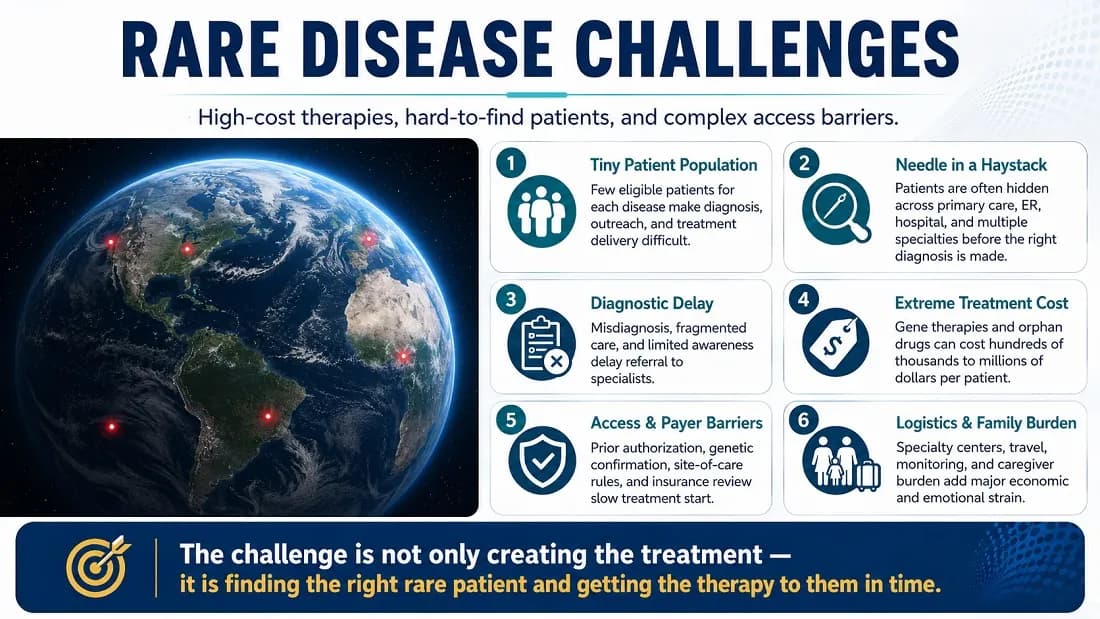
Treating rare diseases creates a brutal economic problem. The treatment may exist, but the patient population is tiny, hard to find, expensive to diagnose, expensive to treat, and difficult to move through the healthcare system. That is why rare disease treatment often feels like finding a needle in a haystack, then trying to deliver a million-dollar therapy through a maze.
The U.S. defines rare diseases as affecting fewer than 200,000 people. The FDA identifies over 10,000 rare conditions affecting more than 30 million Americans, though individual conditions may impact only small numbers. This creates the first economic challenge: tiny markets for any single disease. For pharma companies, this means fewer potential patients, harder clinical trial recruitment, smaller commercial markets, higher per-patient development costs, and pressure to price therapies extremely high. For payers, each case is rare but costs per patient can be enormous.
Development costs for common diseases spread across millions of patients. For rare diseases, this may be impossible. When companies spend years developing therapies for conditions affecting only hundreds or thousands of people, per-treated-patient costs become extremely high. This explains why rare disease drugs, especially gene therapies and biologics, carry very high prices. Reuters reported that gene therapy for metachromatic leukodystrophy was priced at approximately $4.25 million in the U.S., making it one of the most expensive drugs in the country.
The economic tension is obvious: the company needs a high price to justify development, the payer sees a massive claim, and the patient needs access now.
Rare disease trials are difficult because patients are scattered, diagnosis is delayed, and disease progression varies widely. The FDA notes that small patient populations make clinical trials difficult. Added costs include finding eligible patients, genetic testing, travel support, specialty centers, longer recruitment time, smaller datasets, complex endpoints, and reliance on registries or natural history studies. The science may be promising, but trial logistics are expensive.
Many rare disease patients wait approximately six years for accurate diagnosis. During those years, patients may cycle through primary care, urgent care, emergency rooms, hospitalizations, multiple specialists, repeated imaging, lab testing, failed treatments, misdiagnoses, and unnecessary procedures. By diagnosis time, patients may be sicker, more expensive to treat, and harder to rescue.
Even when treatment exists, the patient may not be in the specialist's office. They may be trapped in primary care with vague symptoms, urgent care with repeated flare-ups, emergency departments with acute episodes, hospital admissions without clear diagnosis, or various specialty silos. This is the needle in a haystack issue: the healthcare system is the haystack, and eligible patients are the needle.
Finding these patients requires expensive infrastructure: screening criteria, physician education, genetic testing pathways, referral triggers, EHR search tools, patient registries, care coordinators, specialist networks, and payer documentation support. This costs money before treatment starts.
For common drugs, broad physician marketing works. For rare disease drugs, most doctors may never see an eligible patient. Pharma faces painful marketing inefficiency: educating thousands of physicians to find a handful of patients. Companies must identify providers most likely to encounter the disease: specialty centers, academic hospitals, genetic clinics, pediatric subspecialists, high-volume referral centers, diagnostic labs, and community specialists seeing unexplained symptoms. This makes marketing detective work rather than traditional promotion.
Many rare disease therapies are not simple prescriptions. They may require infusion centers, specialty pharmacies, genetic testing, REMS programs, inpatient administration, transplant-like workflows, cold-chain logistics, trained staff, specialized monitoring, and long-term follow-up. The drug is not just expensive; the delivery system is expensive. Patients may travel to centers of excellence, adding costs for transportation, lodging, time off work, caregiver burden, and coordination.
Rare disease treatments create payer anxiety because one patient can generate huge costs. A single gene therapy, biologic, or enzyme replacement therapy can create major budget events. Payers often respond with prior authorization, genetic confirmation requirements, specialist documentation, step therapy when possible, site-of-care restrictions, specialty pharmacy controls, outcome-based contract discussions, reauthorization requirements, and medical necessity reviews.
For rare diseases, prior authorization can be especially burdensome. Payers may require detailed proof: confirmed diagnosis, genetic test results, disease severity, prior treatment failure, specialist attestation, functional assessment, lab values, chart notes, treatment plan, and monitoring plan. Clinics may submit large documentation packets. Missing information stalls cases.
This creates economic costs for clinics: staff time, physician time, appeals, peer-to-peer calls, patient follow-up, repeated resubmissions, and unpaid administrative labor. For small practices, this can be overwhelming.
Even if insurance covers therapy, patients may face high deductibles, coinsurance, travel costs, time away from work, caregiver burden, fear of side effects, fear of gene therapy or infusion, uncertainty about long-term benefit, and distrust after years of misdiagnosis. Patients may ask: Why is this so expensive? Is it worth the risk? Will insurance really pay? What if it does not work? Access is not only financial; it is psychological and educational.
Rare disease treatments can create enormous value by preventing death, disability, hospitalizations, lifelong complications, or caregiver burden. But proving value is hard with small populations and limited long-term data. Payers ask if the price is justified. Manufacturers answer that the therapy may transform or save a life. Patients ask if they can get it before it is too late. These three economic perspectives often clash.
If patients are not identified early, systems may pay for years of ineffective care before correct treatment is used. Delayed diagnosis causes disease progression, avoidable hospitalizations, disability, lost productivity, caregiver strain, mental health burden, higher lifetime medical costs, and worse outcomes even after treatment.
The economic question should not only be how much the rare disease treatment costs. It should also be what the cost is of not finding and treating the patient earlier.
Rare disease economics are difficult because the system must solve two expensive problems simultaneously: the treatment is extremely costly, and the eligible patient is extremely hard to find. That is the needle in a haystack problem.
The drug may be scientifically advanced. The specialist may be ready. The payer may eventually approve it. But unless the healthcare system identifies the right patient, routes them to the right specialist, documents the diagnosis, secures approval, educates the patient, and delivers therapy, treatment never reaches the bedside.
The real challenge is not just paying for rare disease drugs. It is building an economically sustainable pathway to find the rare patient early and deliver the right treatment before the disease causes irreversible harm.
Related insights.





Book a call

© Copyright 2025 - 2026 · MedBridge Health · All Rights Reserved · For Physicians · Terms of Use · Privacy Policy