
New drugs face a long bench-to-bedside problem. FDA approval proves the product can legally be sold for a specific indication, but it does not guarantee physician adoption, insurance coverage, patient access, or real-world acceptance.
1. Discovery and development: the scientific hurdle
The first challenge is proving that a drug candidate is worth moving forward. A drug starts in discovery, then moves through preclinical testing, clinical trials, FDA review, and post-market safety monitoring.
At this stage, the biggest hurdles are finding a molecule or biologic that actually works, proving safety before human testing, designing trials that show meaningful benefit, selecting the right patients, managing side effects, producing the drug consistently and safely, and generating enough data to satisfy regulators, payers, physicians, and patients.
This is where the drug may be scientifically promising but commercially fragile. A drug can work in controlled trials and still struggle later if it is hard to administer, expensive, poorly covered, or not clearly better than existing options.
2. FDA approval: necessary, but not sufficient
FDA approval is a major milestone, but it is not the finish line. FDA's drug review focuses on whether the drug works, whether the benefits outweigh known risks, and whether it can be used safely for its approved purpose.
But FDA approval does not automatically solve whether physicians know about the drug, whether physicians trust the data, whether clinics can implement the therapy, whether payers will cover it, whether prior authorization will be approved, whether patients can afford it, or whether patients will accept the treatment.
That is the core business problem: regulatory approval opens the door, but market access determines whether patients actually receive the drug.
3. Marketing to physicians: access and trust barriers
Once approved, the drug must be explained to physicians. This sounds simple, but it is one of the hardest steps.
Physicians are busy. Many clinics limit or block pharmaceutical reps. Health systems may restrict visits, samples, lunches, advertising, or direct access. Doctors may also be skeptical because they know pharma has a commercial interest.
Marketing also cannot be casual or exaggerated. FDA's Office of Prescription Drug Promotion states that prescription drug promotion must be truthful, balanced, and accurately communicated. FDA also runs the Bad Ad Program to help healthcare providers recognize and report potentially false or misleading prescription drug promotion.
So pharma must market within a narrow lane: educate, but not mislead; promote, but stay within the approved indication; explain benefits, but also present risks; support physicians, but avoid anything that looks like improper influence; build awareness, but avoid overstepping compliance limits.
This makes physician marketing expensive, slow, and heavily controlled.
4. Physician adoption: the clinical workflow problem
Even when physicians are interested, they still ask practical questions: Is this better than what I already prescribe? Which patients qualify? What labs or documentation are required? What are the side effects? Is it covered by insurance? Does it require specialty pharmacy? Who handles prior authorization? Will my staff be overwhelmed? Will patients complain about cost?
A drug may fail to gain traction not because the science is weak, but because the office workflow is too difficult. If prescribing the drug creates hours of paperwork, phone calls, denials, appeals, and patient frustration, many doctors will avoid it unless the clinical benefit is clearly compelling.
This is especially true for biologics, specialty drugs, injectables, infusion therapies, rare-disease drugs, and high-cost branded medications.
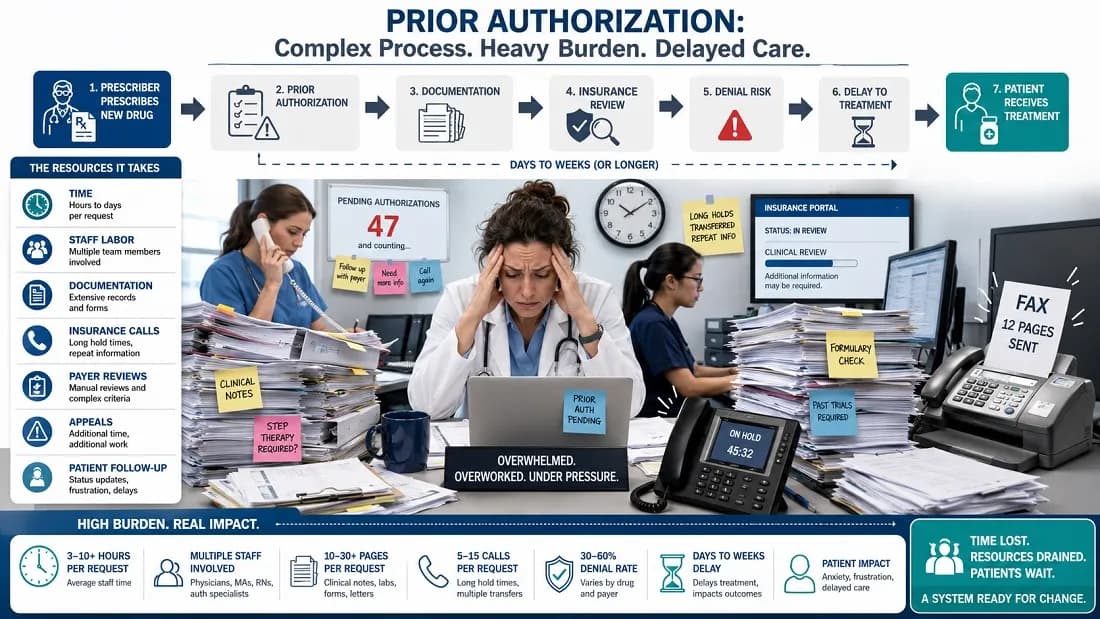
5. Prior authorization: the biggest bedside bottleneck
Prior authorization is where the promise of a new drug often collides with real-world healthcare operations.
The doctor may prescribe the drug, but the payer may require diagnosis codes, chart notes, failed prior therapies, step therapy documentation, lab results, severity scores, formulary exceptions, appeal letters, specialty pharmacy coordination, and repeated follow-up calls.
This frustrates physicians because the clinical decision becomes an administrative battle. The doctor believes the patient needs the treatment, but the clinic has to prove it repeatedly to the payer.
The burden falls on the clinic staff: medical assistants, nurses, billing staff, prior authorization specialists, physicians reviewing forms, and patients waiting for updates.
This creates delay, burnout, and treatment abandonment. For a new drug, this is devastating because early physician experience matters. If the first few prescriptions are denied or delayed, the physician may lose confidence in prescribing it again.
6. Patient education and acceptance
Even if the drug is approved and covered, the patient still has to accept it.
Patients may resist because of fear of side effects, fear of injections or infusions, high copays or deductibles, confusion about why the drug is needed, distrust of new medications, lack of understanding of the disease, frustration with insurance delays, pharmacy access problems, or unrealistic expectations about results.
For chronic diseases, patient education is not optional. Patients need to understand why the drug was chosen, what benefit to expect, how long it may take to work, what side effects to watch for, how to take or administer it, why adherence matters, and what to do if insurance delays approval.
Without patient education, even a clinically appropriate drug may never be started or may be discontinued early.
7. The real bench-to-bedside gap
The pathway looks like this:
Discovery, Clinical trials, FDA approval, Physician awareness, Physician trust, Clinic workflow, Insurance approval, Patient education, Patient acceptance, Actual treatment.
Each step can fail.
The most common breakdowns are not purely scientific. They are operational: pharma cannot easily reach doctors, doctors do not have time to learn complex new therapies, compliance limits how aggressively pharma can promote, payers block or delay access, clinic staff are overloaded, patients cannot afford or understand the treatment, and the drug never reaches the patient despite being approved.
Bottom line
The biggest challenge for new drugs is that FDA approval proves the drug can enter the market, but it does not guarantee the drug can move through the healthcare system.
To succeed, pharma has to do more than market the drug. It must support the full adoption pathway: educate physicians, build clinical trust, simplify access, reduce prior authorization friction, support clinic staff, and help patients understand and accept treatment.
Related insights.





Book a call

© Copyright 2025 - 2026 · MedBridge Health · All Rights Reserved · For Physicians · Terms of Use · Privacy Policy