
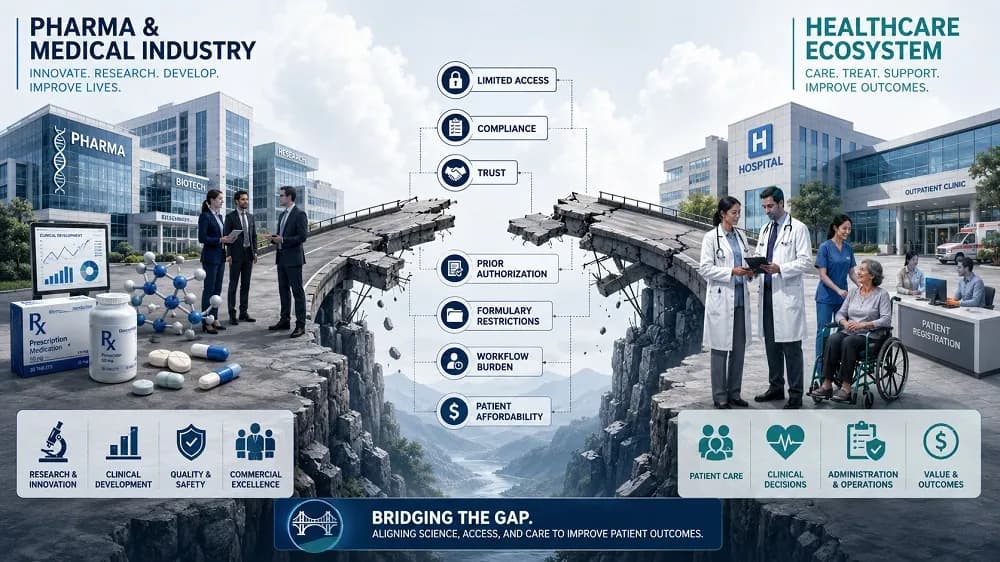
Pharma has a real marketing problem: it needs physicians to know about drugs, indications, safety data, samples, support programs, and coverage pathways, but every method of influence is heavily regulated, increasingly distrusted, and harder to measure.
1. Physician access is harder than before
Traditional sales-rep access is declining. Many physicians are busy, clinic schedules are packed, and health systems restrict rep visits. Even when reps get in, they may only get a few minutes. That makes it difficult to explain complex therapies, new indications, prior authorization requirements, or patient-selection criteria.
This is especially difficult for specialty drugs, biologics, injectables, and high-cost therapies where the physician needs more than a simple brand reminder. They need education, payer guidance, clinical evidence, and workflow support.
2. Compliance risk is high
Pharma cannot simply pay doctors, give excessive benefits, or structure marketing in a way that appears to induce prescriptions. The major legal barriers include:
- Anti-Kickback Statute: prohibits payments or benefits intended to induce referrals or prescriptions reimbursed by federal healthcare programs.
- Stark Law: mainly affects physician financial relationships and referrals for designated health services.
- Sunshine Act / Open Payments: requires reporting many transfers of value to physicians and teaching hospitals.
- FDA / OPDP rules: prescription drug promotion must be truthful, balanced, and not misleading.
This creates a narrow lane: pharma must educate and promote, but cannot appear to buy influence.
3. Promotional messaging must be balanced
Pharma cannot only highlight benefits. Drug marketing usually must include fair balance: risks, contraindications, limitations, approved indications, and safety information. This makes messaging more complex and less emotionally simple than normal consumer marketing.
FDA enforcement has also become more visible. In 2025, FDA issued numerous enforcement letters challenging drug and biologic advertising and promotion, including warning and untitled letters to manufacturers.
4. Doctors are skeptical
Physicians know pharma has a financial interest. Even useful education may be viewed as biased. Many doctors prefer peer-reviewed data, guidelines, real-world evidence, payer coverage information, and colleague experience over sales messaging.
So the challenge is not just getting attention. The challenge is earning credibility.
5. The prescribing decision is no longer controlled by the physician alone
Even if a physician wants to prescribe a medication, the actual path is blocked by:
- Prior authorization
- Step therapy
- Formulary restrictions
- High deductibles
- Pharmacy benefit manager rules
- Specialty pharmacy requirements
- Patient affordability issues
- Staff workload
Pharma can win the physician's clinical interest but still lose the prescription because the clinic cannot get the drug approved, dispensed, or affordable.
6. Digital marketing is crowded and less personal
Pharma has shifted heavily toward digital channels: physician platforms, email campaigns, webinars, sponsored content, programmatic ads, and EHR-adjacent messaging. But physicians are overloaded with digital content. Many ignore pharma emails and banner ads.
Digital marketing scales better than reps, but it often lacks trust, context, and relationship. The physician may see the message but not change behavior.
7. Measurement is difficult
Pharma wants to know whether marketing caused more prescriptions. But attribution is messy. A doctor may see an ad, attend a dinner, speak with a rep, receive an email, and then prescribe months later. Claims data can lag. Privacy rules and institutional restrictions make tracking harder.
Pharma often spends large budgets without clean proof of what actually changed physician behavior.
8. Local clinic workflow is usually ignored
A drug may be clinically appropriate, but the physician's office may not have the operational bandwidth to support it. The weak point is often not the doctor's awareness, it is the clinic workflow:
- Who explains the therapy to the patient?
- Who checks benefits?
- Who submits the prior authorization?
- Who follows up on denial?
- Who handles specialty pharmacy calls?
- Who educates staff on indications?
- Who keeps materials current?
This is where many pharma campaigns fail. They market the product, but they do not solve the office-level friction.
Bottom line
Pharma's biggest challenge is that traditional marketing is no longer enough. The modern problem is not just convince the doctor. It is: reach the doctor, stay compliant, earn trust, support the clinic workflow, help the patient access the drug, and prove the marketing worked.
The strongest opportunity is not just advertising. It is a compliant education-and-access model that helps physicians, clinics, and patients navigate the full path from awareness to approved treatment.
Related insights.





Book a call

© Copyright 2025 - 2026 · MedBridge Health · All Rights Reserved · For Physicians · Terms of Use · Privacy Policy