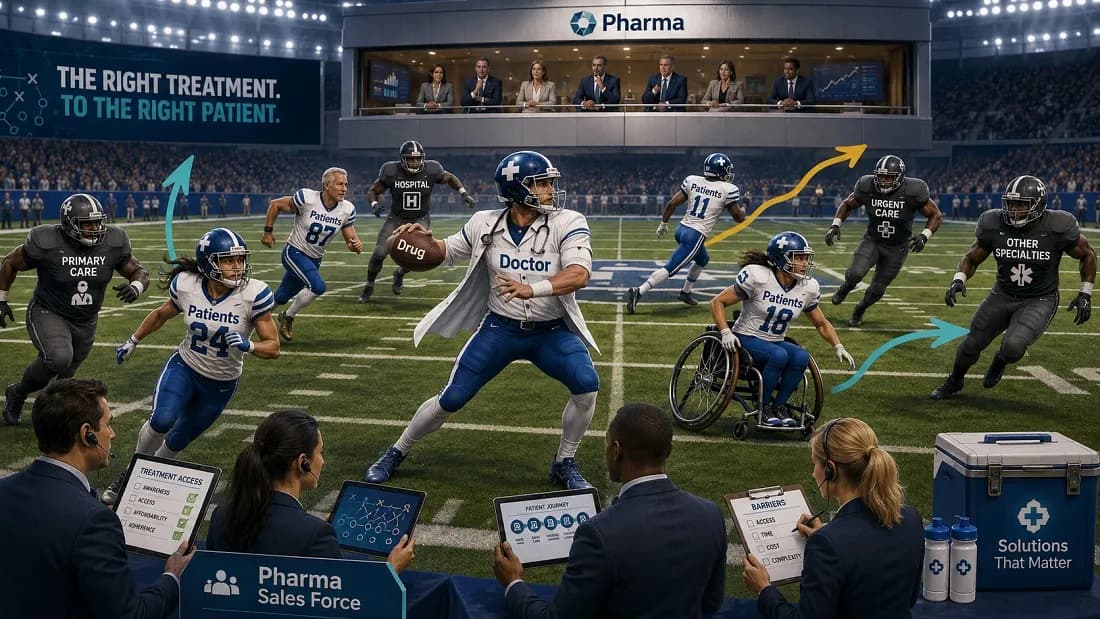
Healthcare marketing is like football because success depends on strategy, positioning, timing, teamwork, and execution, not just having a good product.
Get the right treatment to the right patient.
But just like football, the path is crowded with blockers, defenders, pressure, and missed opportunities.
The quarterback is the doctor
The doctor is the quarterback because the doctor controls the final clinical decision.
The doctor reads the field, evaluates the patient, considers the options, and decides where the ball should go. Even if pharma has a good drug, the rep cannot throw the pass. The doctor has to believe the drug is clinically appropriate and decide to prescribe it.
That means pharma cannot win by shouting from the sideline. It has to help the doctor make a better play.
The football is the drug
The drug is the football because it is the thing everyone is trying to move forward.
A drug sitting in the quarterback's hand does not help anyone. It only matters when it reaches the right patient. FDA approval is like having a legal ball in play, but it still has to move down the field.
The problem is that the drug can be blocked before it reaches the patient.
The patients are the receivers
Patients are the offensive players running different routes.
Not every patient is open. Not every patient is eligible. Some patients are in the wrong setting. Some have insurance barriers. Some are not educated about the treatment. Some are not referred to the specialist. Some cannot afford the medication.
The doctor has to identify the right patient, at the right time, with the right diagnosis, and choose the right treatment route.
The opposing team represents access barriers
The defense is made up of the systems that prevent the treatment from reaching the patient:
- Primary care may hold the patient upstream and delay referral.
- Urgent care may treat the immediate symptoms but not send the patient to the specialist.
- ER may stabilize the patient but not create a specialty-care pathway.
- Hospital systems may discharge the patient without a strong handoff.
- Other specialties may compete for the patient's pathway or treatment decision.
- Insurance adds coverage rules, prior authorization, step therapy, and formulary restrictions.
These defenders are not necessarily bad. They are part of the system. But they create friction. They slow the play down.
The pharma sales force is on the sideline
The sales force is not on the field making the medical decision. They are on the sideline trying to influence the play through education, strategy, awareness, and support.
They can help by giving the doctor and clinic:
- Clinical data
- Patient-identification criteria
- Treatment education
- Payer-access information
- Prior authorization support resources
- Patient assistance information
- Samples, when appropriate
- Workflow guidance
- Reminders about indications and outcomes
But they cannot grab the football and throw it themselves. They have to work through the doctor, the clinic staff, and the healthcare system.
That is why access to the physician matters so much. If the sideline cannot communicate with the quarterback, the play falls apart.
Pharma leadership sits in the box
Pharma leadership sits above the field watching the entire game.
They see sales numbers, prescribing trends, market share, payer coverage, territory performance, and return on investment. From the box, the game looks like strategy and data.
But down on the field, the rep is dealing with reality:
- Blocked clinic access
- Skeptical physicians
- Overwhelmed staff
- Prior authorization frustration
- Competing products
- Limited time with doctors
- Patients stuck before referral
- Insurance delays
This is the gap between corporate strategy and real clinic execution.
Prior authorization is like a penalty flag or blocked play
Even when the doctor makes the right pass, prior authorization can stop the play.
The doctor may prescribe the drug, the patient may need it, and the rep may have done the education, but then insurance says:
- Prove the diagnosis
- Show failed prior therapy
- Submit records
- Use a preferred alternative first
- Wait for review
- Appeal the denial
That is like completing the pass, only to have the play called back.
For doctors, this is frustrating because the clinical decision becomes an administrative fight.
Patient referral is the route-running problem
The best treatment cannot work if the patient never runs the route to the specialist.
Many patients remain stuck in primary care, urgent care, ER, or hospital discharge settings. The specialist may be ready, but the patient never reaches the specialist's office.
That is like having a receiver open downfield, but the quarterback never sees them, or the receiver never gets into the play.
The winning play is coordination
Healthcare marketing works when all parts of the play align:
- Pharma identifies the opportunity.
- Sales reps educate and support the clinic.
- Doctors trust the data.
- Clinic staff can manage the workflow.
- Patients are identified and referred.
- Insurance access is handled.
- The patient understands and accepts treatment.
That is the full play.
Bottom line
Healthcare marketing is like football because having a good drug is not enough.
You need the right play call, the right quarterback, the right patient route, protection from blockers, sideline support, and execution under pressure.
The real goal is not just to sell the drug.
Getting the ball to the end-zone is moving the treatment through a crowded healthcare field and getting it safely to the right patient.

Related insights.





Book a call

© Copyright 2025 - 2026 · MedBridge Health · All Rights Reserved · For Physicians · Terms of Use · Privacy Policy