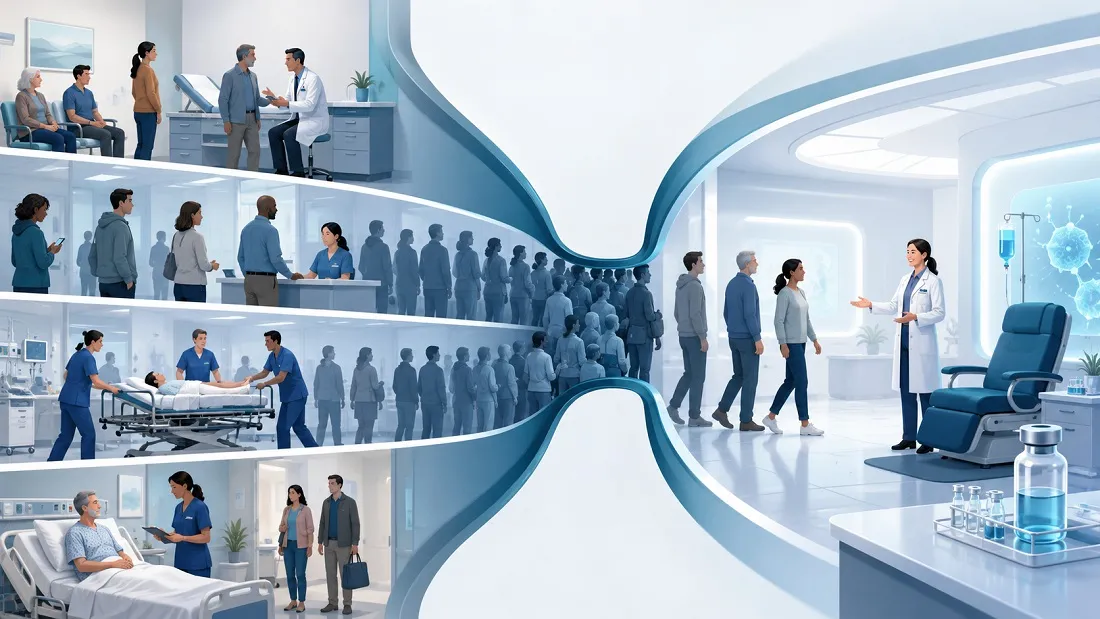
A new treatment can be FDA-approved, clinically valuable, and available through trained specialists, but patients may never reach the specialist because they remain trapped in the wrong care setting: primary care, urgent care, ER, or hospital discharge pathways. This is a major last-mile access problem in healthcare.
Core problem
The problem is not only whether the treatment exists.
The problem is whether the right patient is identified, educated, referred, scheduled, approved, and treated.
Specialists may be ready. Pharma may have educated the specialists. The treatment may be clinically appropriate. But the patient pathway often breaks before the patient ever reaches the specialist.
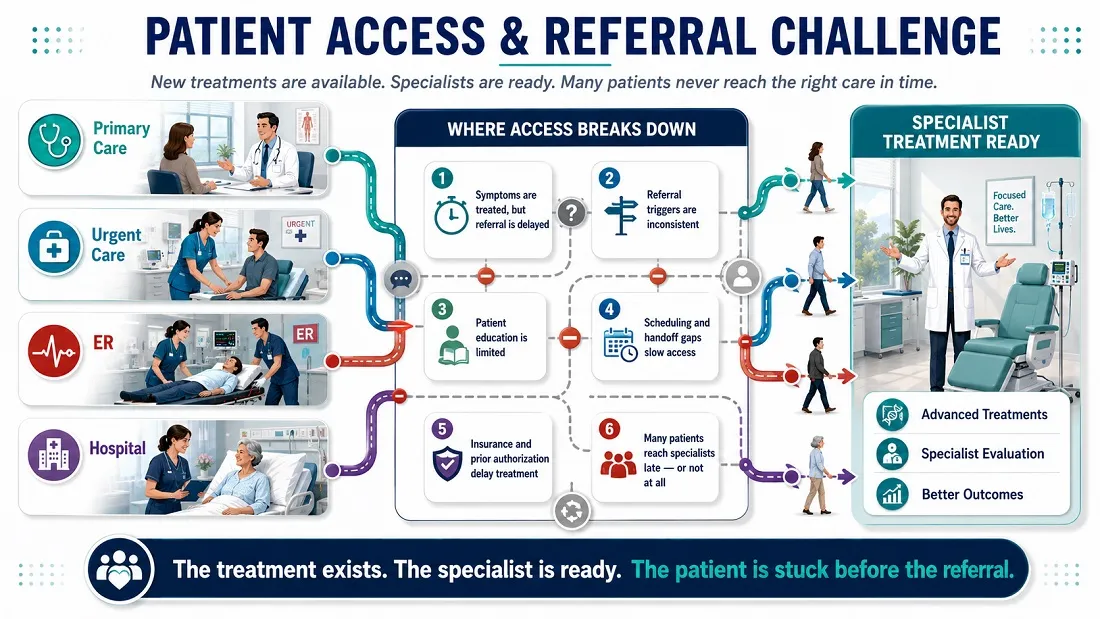
1. Primary care becomes the bottleneck
Primary care physicians are often the first point of contact. They manage many conditions and see large patient volumes. Even when they recognize the condition, referral may be delayed because:
- Symptoms are treated conservatively first
- The condition is not recognized as specialty-level
- The PCP is unaware that a newer treatment option exists
- The referral process is time-consuming
- The patient does not understand why a specialist is needed
- The patient has insurance or network barriers
- The PCP office does not have time to educate the patient deeply
Primary care is not the enemy. It is overloaded. The PCP may be managing diabetes, hypertension, depression, infections, medication refills, lab results, and preventive care in the same visit. A newer specialty treatment may not rise to the top unless the referral trigger is very clear.
2. Urgent care treats the episode, not the disease pathway
Urgent care is designed for speed. It handles acute symptoms, not long-term disease navigation.
A patient may present repeatedly with symptoms that actually suggest a chronic or specialty-managed condition. But urgent care often gives temporary treatment: antibiotics, steroids, inhalers, pain medications, topical treatments, short-term symptom relief, and a follow-up-with-your-doctor instruction.
The patient leaves without a true referral pathway. The urgent care visit closes, but the underlying disease remains. This is a missed access point for new treatments.
3. ER and hospital settings stabilize patients but rarely connect them to specialty treatment
The ER and hospital are focused on immediate risk, stabilization, and discharge. They may recognize that a patient needs follow-up, but the referral handoff is often weak.
Common breakdowns:
- Discharge instructions are generic
- Specialist follow-up is recommended but not scheduled
- Patient does not understand urgency
- No one confirms appointment completion
- Insurance authorization is not handled
- Records do not transfer cleanly
- The patient returns to the same cycle later
This is especially frustrating when the specialist has an effective treatment available, but the patient keeps cycling through ER and hospital care without reaching the clinic that can actually manage the condition long-term.
4. Specialists may be educated, but the upstream providers are not
Pharma often focuses on educating specialists because specialists are the prescribers. That makes sense clinically, but it misses a major access problem.
For many conditions, the patient is not sitting in the specialist's office. The patient is sitting in primary care, urgent care, ER, hospital discharge, community clinics, or retail clinics.
So the specialist may be fully prepared to offer the new therapy, but upstream providers may not know which patients qualify, when to refer, what symptoms should trigger referral, what tests are needed before referral, which treatments are now available, how soon the patient should be seen, or how to explain the value of specialty care.
This creates a disconnect: the treatment is available at the specialist level, but patient detection happens upstream.
5. Referral leakage is a major hidden problem
Even when a referral is made, many patients never complete it.
Reasons include the patient not answering scheduling calls, the specialist office not reaching the patient, insurance authorization requirements, referrals sent to the wrong clinic, patients declining the visit, distant appointments, weak explanation of benefit, transportation or cost concerns, and no follow-up system to confirm completion.
This is called referral leakage or referral drop-off. It is one of the biggest barriers between treatment availability and actual treatment delivery. A referral is not success. A completed specialist visit is success.
6. Patient education is weak at the point of referral
Patients often do not act on referrals because they do not understand the why.
They may think their primary doctor already gave them medicine, they feel better now, they do not want another appointment, it sounds expensive, they do not know what the specialist will do, they do not want a new drug, or they will wait until it gets worse.
For new treatments, this is even harder. Patients need simple education before they accept the referral: what condition may be causing the symptoms, why temporary treatment may not be enough, what the specialist can evaluate, what new treatment options may exist, why earlier treatment may prevent worsening, and what the next step is.
Without this, the patient does not feel urgency.
7. Insurance and prior authorization add another barrier
Even after the patient reaches the specialist, the treatment may still be blocked by prior authorization, step therapy, formulary restrictions, specialty pharmacy delays, high copays, deductible exposure, missing chart documentation, and payer-specific criteria.
So the patient access pathway has two major gates:
- Gate 1: getting the patient to the specialist
- Gate 2: getting the treatment approved and started
Many strategies focus only on Gate 2. But if the patient never reaches the specialist, prior authorization never even begins.
8. The system is fragmented
Each setting sees only part of the patient journey.
Primary care sees the recurring symptoms. Urgent care sees the flare. ER sees the crisis. Hospital sees the admission. Specialist sees the advanced disease, if the patient gets there. Pharma sees the treatment opportunity. The patient sees confusion.
No one owns the full pathway unless a structured referral and education system is built.
Strategic opportunity
The solution is not just market the drug.
The stronger strategy is to build a patient-identification and referral bridge between upstream care settings and specialists. That means helping primary care, urgent care, ER, and hospital teams recognize which patients should be referred earlier.
A strong model would include:
- Simple referral criteria
- Visual screening prompts
- Patient education materials
- Direct scheduling pathway
- Specialist contact information
- Referral tracking
- Follow-up confirmation
- Prior authorization support after specialist evaluation
- Feedback loop to referring providers
Bottom line
For new treatments to succeed, pharma and specialists cannot focus only on educating the final prescriber. They must also solve the upstream access problem.
The real pathway should be:
Awareness, Patient identification, Referral trigger, Patient education, Appointment scheduling, Specialist evaluation, Prior authorization, Treatment start.
If any step fails, the patient never reaches the therapy, no matter how good the drug is.
Related insights.





Book a call

© Copyright 2025 - 2026 · MedBridge Health · All Rights Reserved · For Physicians · Terms of Use · Privacy Policy